
Vinyl Wednesday: Heretic Pride
The Mountain Goats
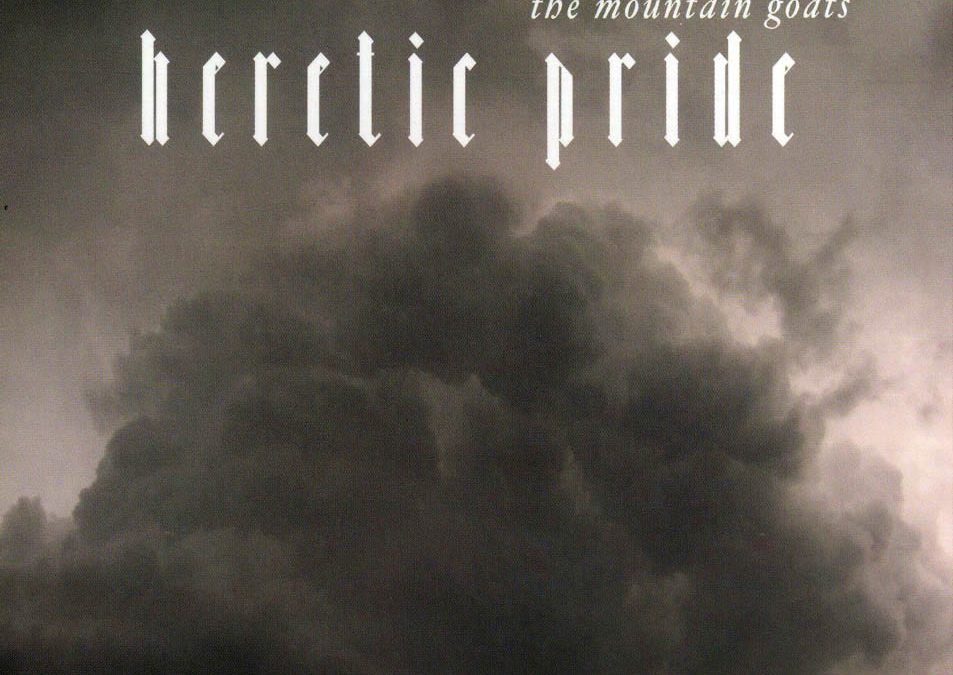
 Welcome back to Vinyl Wednesday! This week I’m going to talk about another one of my favourite bands, The Mountain Goats. This is another band I was introduced to by way of a friend, who shared her copy of The Sunset Tree with me back in 2010 or 2011. I didn’t start seriously listening to them until a few years after that, though. When I did I was working a crummy job where I was trapped in a cubicle all day long with limited human contact, and I started working my way thorough various bands’ discographies via Apple Music in an effort not to go completely nuts. The album I’m talking about today, Heretic Pride, resonated with me particularly strongly at the time as I was figuring out how to leave that job and look for another one (which was by no means been the end of that narrative, but that’s a story for another day).
First, a little bit of background. The Mountain Goats are based in Durham, North Carolina, and are fronted by singer-songwriter John Darnielle. For the first period of the band’s existence, dating to around the early 90s, Darnielle was the only member, and recorded his songs onto cassette tapes via an old boom box. These days he records and tours with a full band, but Darnielle’s songwriting remains the driving force. A prolific and gifted writer who has also penned two novels (Wolf in White Van and Universal Harvester), Darnielle’s lyrics are rich and complex, and tend to follow a narrative structure which, as we have established, I am a fan of. Mountain Goats songs abound with biblical and literary references, Latin quotes, and evocative scene-setting. Some albums follow a narrative (Talahassee, Beat the Champ), and some are autobiographical (The Sunset Tree, We Shall All Be Healed); many of them are tied to specific locales (All Hail West Texas, Transcendental Youth).
Heretic Pride is a bit unique among Mountain Goats albums in that it doesn’t have a single cohesive theme. Instead, each song stands on its own and tells a narrative story. The opening track, Sax Rohmer #1, lives up to its namesake by playing out like a pulp spy-novel, and later tracks explore themes like teen pregnancy (San Bernardino), the paranoid racism of H.P. Lovecraft (Lovecraft in Brooklyn), the (true) murder of a Rastafarian deejay (Sept 15th, 1983), and the (fictional) last hurrah of a B horror film actor (Michael Myers Resplendent). The entire album is suffused with biblical references, which are a common theme in Darnielle’s songwriting.
Part of what makes The Mountain Goats so fascinating is Darnielle as a narrator. A survivor of childhood abuse, lover of Mexican professional wrestling, recovered methamphetamine addict and later psychiatric nurse, practicing Christian, expert on thrash metal, and a staunch supporter of Planned Parenthood, the man contains multitudes. His lyrics are suffused with his own life experiences and his gift for storytelling, and you get the sense when you listen to his songs that in telling his stories he is trying to express a commonality in not just his own experiences, but the human experience. There’s also a real love for society’s outcasts that comes across in his songwriting, which is a major theme throughout The Mountain Goats’ discography. Darnielle’s podcast, I Only Listen to the Mountain Goats, in which he dissects his albums (All Hail West Texas in season 1 and In League With Dragons in season 2) song-by-song in conversation with fellow writer and Welcome to Night Vale creator Joseph Fink, is an interesting look into his writing process, worldview, and experiences and is well worth a listen. I was fortunate enough to see The Mountain Goats live in Ottawa back in May, and Darnielle’s stage presence is contagiously joyful – he played the whole show with a huge grin on his face, like he still can’t believe that this is what he gets to do for a living. He also came out and greeted the fans lined up at the doors to the venue, which was pretty cool.
But back to Heretic Pride. Darnielle’s identifying with the underdog becomes especially obvious in the title track, which follows a narrator who has been set upon by the townsfolk for heresy and is being carried off to their public execution. This can, of course, be interpreted in lots of different ways but to me it reads as a witch burning. At the time that I was becoming really familiar with this album I was, as I mentioned, experiencing the death knells of a truly terrible job experience within a company that was slowly sucking away my soul. Being a creative trying to work inside of a corporate structure can be, and was for me, a thankless position. I listened to this song on repeat over a period of about eight weeks while I was hatching and then executing my escape plan, identifying (somewhat melodramatically) with the narrator who, even though they’re about to be killed, is so certain of their righteousness that they feel a sense of pride at finally reaching this moment of reckoning.
I think a lot of good music ends up being tied to the place and time in your life where you first experienced it; that has certainly been the case for me. What’s great about a band like The Mountain Goats is that their discography is so extensive and varied that their music can evolve and change with you as you move through different challenges and life events. There is a Mountain Goats album for every mood, and if you’re feeling rebellious and put-upon, and like you need to change life directions while also sticking it to the man in whatever capacity is available to you, then Heretic Pride can be your soundtrack.
If you’d like to listen to the album in its entirety you can find it on Spotify, Apple Music, and Google Play. If you’d like to pick up a copy on vinyl, you can find it here. That’s all for this week, but check back next Wednesday for another foray into my vinyl collection; I’m thinking of talking about something a little bit older next week so stay tuned, and Hail Satan.
**This post contains affiliate links and I will be compensated if you make a purchase after clicking on my links.
comments